Few frequency ranges illustrate the tension between licensed professional users, unlicensed consumer devices, and secondary amateur allocations as clearly as 410 to 450 MHz. Across just 40 MHz of UHF spectrum, this band carries federal government land mobile systems, commercial and public safety two-way radio, the European ISM allocation that hosts hundreds of millions of consumer devices, and the lower half of the 70-centimetre amateur band — all sharing spectrum in ways that require careful coordination and produce regular interference disputes.
410 to 420 MHz: federal land mobile and space research
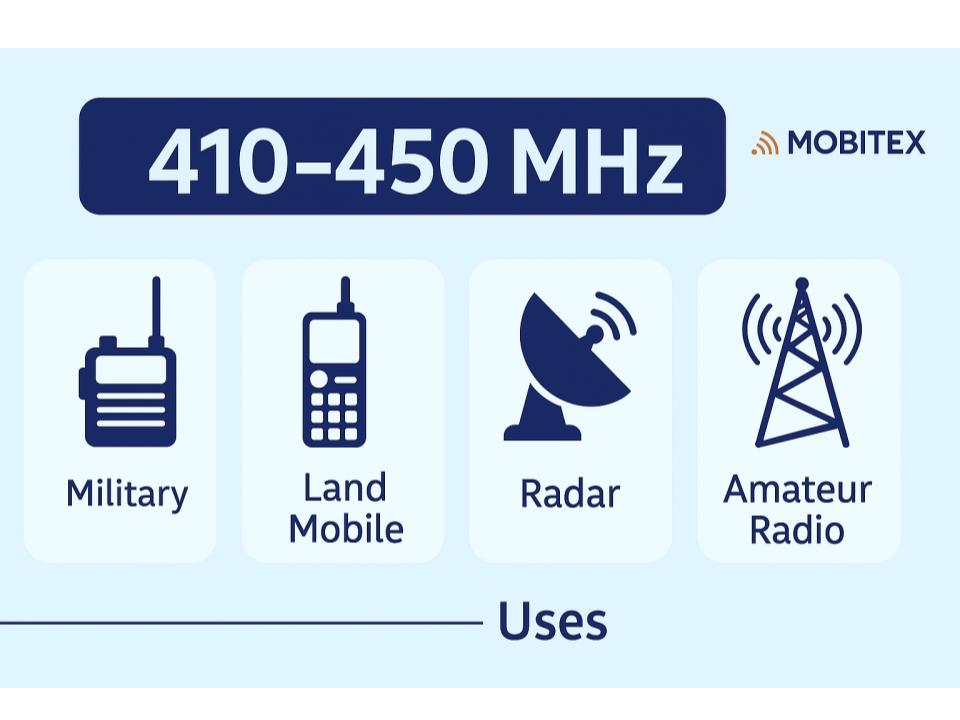
The 410 to 420 MHz segment is part of the broader 406.1 to 420 MHz federal land mobile block, used by agencies including the US Coast Guard, Department of the Army, Department of Commerce, the Federal Aviation Administration, Department of Homeland Security, and Department of Agriculture. These are narrowband FM and digital voice systems operating on 12.5 kHz channel spacing following the NTIA’s narrowbanding mandate, supporting dispatch, field operations, and inter-agency coordination across geographically dispersed users.
The segment also carries a space research allocation in the space-to-space direction — communications between orbiting spacecraft rather than ground-to-orbit links. This allocation supports extravehicular activity communications from the International Space Station and similar manned programmes, operating on frequencies coordinated through the ITU on an as-needed basis without displacing the primary land mobile users below.
420 to 430 MHz: radiolocation, radar, and restricted amateur access
As covered in the previous article in this series, the 420 to 430 MHz range carries a primary radiolocation allocation used for high-powered military and government radar systems. These include radars in some countries used to detect and track earth-orbiting satellites and space debris, including identification of potential hazards to the International Space Station.
In the United States, the amateur service holds a secondary allocation in the 420 to 450 MHz range, but is excluded from operating north of Line A — roughly the US-Canada border — and is prohibited within 160 kilometres of specific military radar sites including Clear, Alaska; Concrete, North Dakota; and Otis Air Force Base, Massachusetts. These geographic restrictions protect sensitive radar receivers from interference that would degrade their space surveillance capability.
430 to 440 MHz: the 70cm amateur core and the 433 MHz ISM layer
The 430 to 440 MHz segment is internationally allocated to amateur radio, and in ITU Region 1 — covering Europe, Africa, and northern Asia — the amateur service holds co-primary status alongside radiolocation. In ITU Regions 2 and 3, including the Americas and Asia-Pacific, amateur stations hold secondary status and must not cause harmful interference to, nor claim protection from, radiolocation stations authorised by other nations.
Layered within this amateur allocation, the 433.050 to 434.790 MHz window carries an ISM (industrial, scientific, and medical) designation in ITU Region 1, creating one of the busiest licence-free sub-bands in the UHF spectrum. LPD433 devices are authorised for licence-free voice communications in most of Europe with 25 kHz channel spacing across 69 channels, and European remote keyless entry systems routinely use 433 MHz, sitting within the 70-centimetre band allocated to amateur radio and producing interference as a result.
Automotive remote keyless entry systems typically operate at 315 MHz in North America or 433 MHz in Europe and most of the rest of the world. That means the key fob in hundreds of millions of European vehicles transmits on a frequency that is simultaneously allocated to licensed amateur radio operators — a coexistence that works in practice because the keyless entry transmitters are low power, short range, and intermittent, but that creates a measurable noise floor across the entire 433 MHz ISM window.
Beyond keyless entry, the 433 MHz band is used for keyless entry systems, basic telecontrol, home automation, wireless alarms, and IoT sensor applications. Less than 2 MHz of bandwidth is available and applications such as voice, video, and continuous data transmission are typically not permitted, restricting its use to short-burst, low-duty-cycle transmissions. LoRa (Long Range) modulation has become a significant user of this sub-band in Europe, with IoT devices transmitting sensor data from agricultural, industrial, and smart metering applications at data rates of a few hundred bits per second but over ranges that can exceed several kilometres.
440 to 450 MHz: commercial land mobile
Above the amateur allocation, the 440 to 450 MHz range transitions into commercial and public safety land mobile territory. In the United States this segment sits within the broader 450 to 470 MHz land mobile block — UHF land mobile systems in this range use a standardised repeater pairing with a +5 MHz split, meaning a repeater output at 451.375 MHz has a mobile input of 456.375 MHz. Analogue FM as well as digital voice modes including DMR, Motorola TRBO, NXDN, and P25 trunking systems are all in use across this range.
APCO Project 25, established in 1989 as a joint federal, state, and local effort, set common technical standards for VHF and UHF radio systems used by public safety agencies. P25 conforming radios use digital modulation to reduce bandwidth from 25 kHz analogue FM channels to 12.5 kHz first-generation digital channels, with second-generation systems targeting 6.25 kHz. P25 systems operate across multiple bands including UHF, VHF, 700 MHz, and 800 MHz, but the UHF band in the 440 to 512 MHz range remains a significant installed base for public safety agencies that migrated to digital narrowband during the FCC’s mandated transition completed in 2013.
Narrowbanding and the migration legacy
In 2004, the FCC required all Part 90 VHF and UHF private land mobile radio licensees operating legacy 25 kHz wideband systems to migrate to 12.5 kHz narrowband systems by January 1, 2013. The 421 to 470 MHz UHF band was explicitly included in this mandate. The transition forced a wholesale replacement of legacy radio fleets across public safety, commercial, and government users — a process that accelerated the adoption of digital voice standards and created the mixed analogue-digital environment that characterises the band today.
A band under multiple pressures
The 410 to 450 MHz range is in many respects a microcosm of UHF spectrum management challenges. Federal land mobile systems in the lower segment compete for coordination with radio astronomy protection zones. The 433 MHz ISM layer sits uncomfortably inside an amateur secondary allocation, producing routine interference in dense urban environments. High-powered radars exclude amateur operations from entire geographic regions. Commercial land mobile systems press toward the lower 440s as channel congestion in the 450 to 470 MHz core intensifies. And as covered in the previous article, commercial satellite operators are beginning to eye the 430 to 440 MHz amateur window for TT&C operations — adding orbital pressure to a band already managed on fine margins at ground level.